
Introduction
C35 is a high-quality carbon structural steel with a moderate carbon content of 0.35% as per European standards. It offers a balance between strength, plasticity, and process performance. While its welding performance is slightly inferior compared to C22, it remains acceptable. C35 is typically used in normalized or quenched and tempered conditions.
- Moderate strength and toughness.
- Good machinability.
- Acceptable weldability.
- Suitable for heat treatment to improve hardness.
- Reasonable wear resistance.
- Moderate hardenability.
Uses/Applications:
- Machinery parts: Shafts, gears, axles, rotating parts.
- Automotive: Connecting rods, levers.
- Agricultural Equipment: Components subjected to moderate stress.
- Structural components: Beams, sleeves, wheels, rings.
- Fasteners: Screws, nuts, washers.
- Seamless steel pipes.
Standards and Equivalent Grades:
| Country | Standard | Grade |
|---|---|---|
| China | GB 3077 | 35 |
| USA | ASTM A29 | 1035 |
| Japan | JIS G4051 | S35C |
| UK | BS970 | 080M36 |
| France | NFA 33-101 | AF55-C35 |
| ISO | ISO 683-1 | – |
Chemical Composition (wt. %):
| Standard | Grade | C | Si | Mn | P | S | Cr | Mo | Ni |
| EN10083 | C35/1.0501 | 0.32-0.39 | ≤0.4 | 0.50-0.80 | ≤0.045 | ≤0.045 | ≤0.4 | ≤0.1 | ≤0.4 |
| DIN 17200 | CK35/1.1181 | 0.32-0.39 | ≤0.4 | 0.50-0.80 | ≤0.035 | ≤0.03 | – | – | – |
| SEW550 | CK35/1.1181 | 0.32-0.39 | ≤0.35 | 0.50-0.80 | ≤0.035 | ≤0.035 | – | – | – |
Physical Properties:
| Property | Value |
| Density (g/cm³) | 7.87 |
| Melting Point (°C) | 1395 |
| Specific Heat Capacity (J/kg.k) | 482 |
| Thermal Conductivity (W/m.K) | 46 (100°C) |
| Elastic Modulus (MPa) | 212,213 |
| Shear Modulus (MPa) | 82,080 |
| Poisson’s Ratio | 0.29 |
| Linear Expansion Coefficient (10^-6/k) | 12.45 (0-100°C) |
Dimensional Tolerances:
| Surface Finish | Tolerance |
| Black-Forged | (0, +5mm) |
| Black-Rolled | (0, +1mm) |
| Turned | (0, +3mm) |
| Grinding | Best h9 |
| Polished | Best h11 |
| Peeled | Best H11 |
| Cold Drawn | Best H11 |
Mechanical Properties:
| Property | Value |
| Tensile Strength (MPa) | 500-650 |
| Yield Strength (MPa) | 280-380 |
| Elongation (%) | 20-25 |
| Reduction of Area (%) | ≥45 |
| Impact Charpy-V (J) | ≥55 |
| Hardness (HB) | 140-180 |
Forging:
| Parameter | Value |
| Initial Forging Temp. | 1200°C |
| Final Forging Temp. | 800°C |
| Forging Ratio | Above 4:1 |
| Post-Forging Treatment | Slowly cool |
Heat Treatment:
| Process | Temperature (°C) | Cooling Method |
| Annealing | 850-880 | Cooling in furnace |
| Normalizing | 860-900 | Cooling in air |
| Hardening | 800-840 | Quenched in oil or water |
| Tempering | 500-600 | Adjust strength/toughness |
Critical Temperatures:
- Ac1: 724°C
- Ac3: 802°C
- Ar1: 680°C
- Ar3: 774°C
Machinability:
- Moderate machinability, better than higher carbon steels.
- Can be machined in annealed conditions for best results.
Weldability:
- Acceptable but slightly inferior to lower carbon steels.
- Pre-heating may be required for thicker sections.
Corrosion Resistance:
Limited corrosion resistance. Surface treatments like galvanizing or coating are recommended for improved performance.
Available Form:
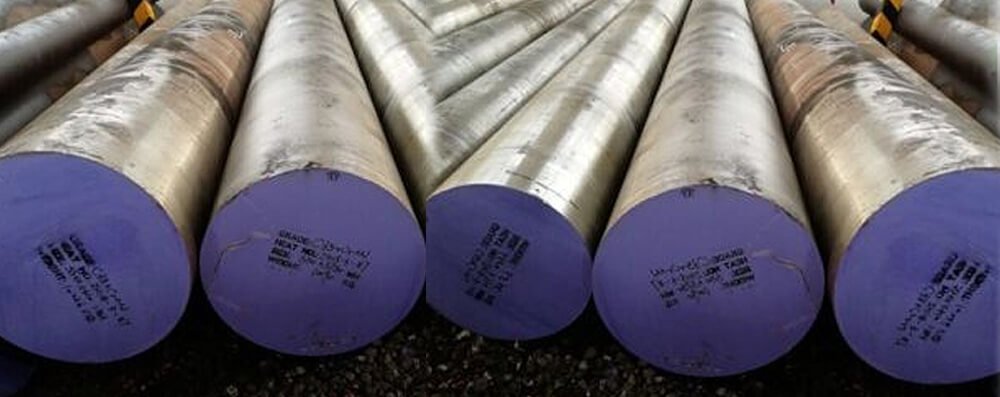
Round Bars, Rods.
Conclusion:
C35 carbon steel is a versatile material offering a good balance between strength, machinability, and toughness. It is widely used in automotive, machinery, and structural applications due to its moderate carbon content and ability to undergo heat treatment. Though its corrosion resistance and weldability are modest, proper surface treatments can enhance performance.